Bersaglieri
The Bersaglieri (also spelled Bergsaglieri were first formed by General Alessandro La Marmora in 1836 to serve in the Piedmontese Army, which later became the Royal Italian army. Bersaglieri is Italian for sharpshooters". From the beginning the Bersaglieri have been a quick reaction force. The force has always remained all volunteer, highly trained and highly mobile. After World War I the Bersaglieri became bicycle mounted infantry making them effectively as mobile as Horse Cavalry but without the need of caring for horses.. Shortly before World War II, they traded in their bicycles for motorcycles. The motorcycle of choice was the The Moto Guzzi Alce (Elk), a six cylinder 500 cc bike. Some of these bikes mounted a M30 light machine gun over the handle bars. The bike normally need to be stopped before firing the machine gun.
During World War II, the Bersaglieri maintained their high standards despite a shortage of personnel. In all, 12 Bersaglieri regiments were raised during the war. They fought with distinction and had a reputation for toughness. Besides their role as light infantry, they also acted as scouts and convoy escort duty. Today most Bersaglieri are mechanized battalions within the Italian Army but are still regarded as some of the best infantry in the world.
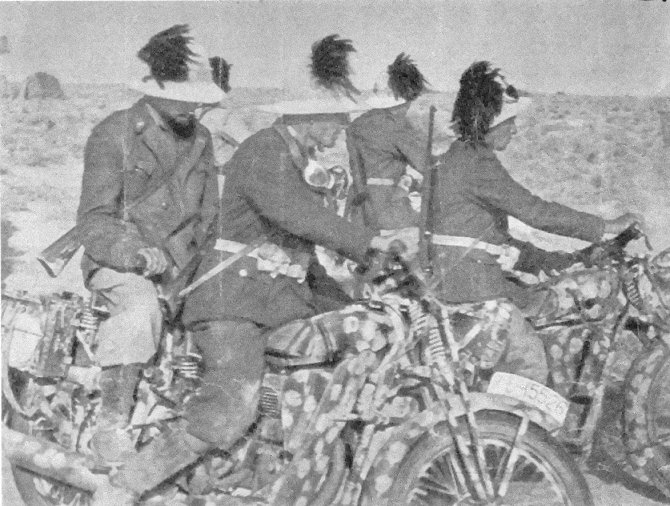
Bersaglieri on patrol with camouflaged Moto-Guzzis Elks
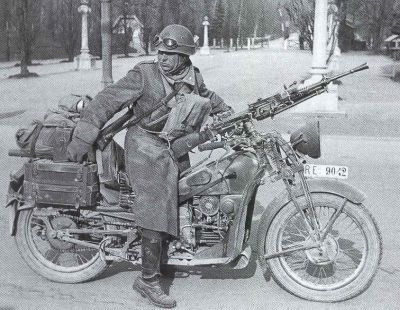
Moto-Guzzi Elk with M30 Lt. MG.
Folgore (Paratroopers)
In the 1941 the 185th Parachute Division Folgore was formed by Italy. The unit’s originally was to assault Malta during Operation Hercules. It was later deployed to North Africa where it deployed as regular light infantry. When the unit deployed, they were forced to remove any distinguishing insignia. The primarily operated in North Africa wearing the typical tropical dress and not the distinctive uniform of Italian paratroopers.
Folgore is best remembered for its actions during the Second battle of El Alamein. Division Folgore fought off the advance of six British divisions, two armored and four infantry, thus provoking the respect and the admiration of the English enemies. The Folgore Parachute Division had already proved its worth when, at the end of September, they gave very short shrift to a local attack by the British 31st Infantry Brigade.
As with most Italian infantry, when the German fell back using motorized transport, most Italians had to walk. This was the case of the Folgore Division. Unlike many Italian division which felt deserted by the Germans and simply surrendered, the folgore continued to fight until it ran out of ammunition. Even at this point some battalions of the division chose bayonet charges to the white flag. When the division was finally defeated by the British, it was allowed to surrender without raising a white flag. By then the Folgore Division was reduced to around 600 men. Shortly afterwards, General Hughes of the 44th Infantry Division was quoted as saying , "I wish to say that in all my life I have never encountered soldiers like those of the Folgore."
The divison was later reconstituted as the Folgore Battalion and took up the defense of Takruna, Tunisia, again proving themselves to be some of the best soldier in the Italian Army.
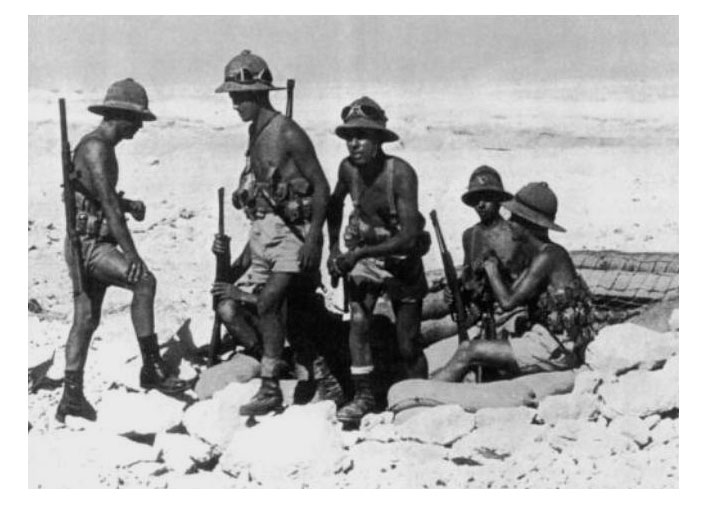
Folgore Paratoopers in North Africa
La Compania Auto-Avio-Sahariana "Cufra"
The Auto-Saharan Company was an Italian military unit specializing in long range desert patrolling throughout the Libyan desert , from the late 1930s to the Italian surrender in 1943. While exploring the desert, Bagnold actually encountered one of the units before hostilities began between Italy and Britain. The capture of Pat Clayton is also attributed to the Auto Saharan.
The company was comprised of desert veterans often operating in the AS 42 Sahariana equipped with heavy machine guns and 20 mm AA weapons, together with some armored cars. The company also had the support of its own aircraft (normally Fiat CR.42 Falco or Falcons) to assist in long range reconnaissance and ground attack.
The main difference between the Auto Shararan and the LRDG is the Auto Saharan looked for the LRDG in Axis held territory and only once ventured into enemy held territory. The unit also acted as short range scouts and convoy escort for the Italian/German Army. Having their own aircraft permanently attached meant they could easily conduct aerial reconnaissance and provide quick reaction on the ground.
The most famous of the units was Raggruppamento Sahariano AS but later four additional companies were formed. The AS 42 Saharan trucks were armed with a variety or machine guns and cannons including:
- Breda Mod. 37 Medium Machine Gun
- Solothurn S18/1000 semi-automatic 20mm Anti-Tank Rifle (10 round magazines).
- Breda Mod. 35 20mm Dual Purpose AA Gun (uses 12 round "chargers").
- 47mm Mod. 37 Anti-Tank Gun.
After the Desert war ended, the Auto Saharan continued for a short time in Italy however with the surrender of the Italy shortly after the Desert war, there actions were limited.
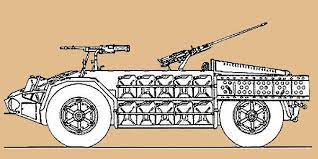
AS42 Saharan, with 8mm Breda and Solothurn S18/1000 AT Rifle.
X-MAS
The Decima Flottiglia MAS (Decima Flottiglia Mezzi d'Assalto, also known as La Decima or X MAS) (Italian for "10th Assault Vehicle Flotilla") was an Italian frogman using human piloted torpedoes to attack British shipping.
In 1940, Commander Moccagatta of the Italian Royal Navy reorganized the First Flotilla into the Decima Flottiglia MAS, secretly equipping the unit with siluri a lenta corsaor "slow-running torpedoes" or manned torpedos. Nuotatori, Italian for swimmers or frogmen were trained to ride the SLC toward Enemy ships. While dangerous, this was not a suicide mission. The torpedoes would detach a magnetic war head on to the enemy ship and then the frogmen would ride the small craft back to safety.
The Italian frogmen comprised two units. One specialized in operations where the nuotatori swam to their attack site, one in the use of manned torpedoes. The manned torpedoes were electrically propelled torpedoes with two crewmen equipped with diving suits riding astride. They steered the torpedo at slow speed to the enemy ship. The detachable warhead would magnetically attach to the ship's side.. The frogmen then rode the torpedo away.
While officially the manned torpedoes used by the Italians were called siluri a lenta corsaor they were normally called "Il Maiale" (The Pig) The electric motor made it very quiet however it had a top speed of about 4.5 knots and a max range of 24 km. The British later copied the Italian torpedoes and developed their own manned torpedoes, naming them "Chariots.
SLC 200 "Pig" and Italian frogmen with re-breathers. (Cover Art from a model kit issued by Italeri)